No Game Engine: Taking Apart Tesla's Reality View
Tesla started shipping FSD v15 yesterday. The headline feature is the thing on the centre screen. It’s called Reality View, and it looks like someone is flying a drone behind your car and streaming the footage to the dashboard, with a glowing blue path painted on the road and arrows hanging in the air where you’re about to turn.
My first reaction was the obvious one. That’s a game engine. Detected objects go in, a renderer places 3D car models and a path mesh, done. I’ve built that pipeline. Everybody has.
It isn’t that. According to Tesla there are no car models, no path mesh, and no engine. Every pixel of the scene comes out of a neural network. This post is me taking that claim apart: what’s on the screen, what must be behind it, why it runs in real time, and what I’d build next.
One warning before we start. The release is one day old. Tesla has published no paper. What I have is the release notes, a few posts from Ashok Elluswamy, and two replies from Elon Musk on X that turn out to be the most technical thing anyone at Tesla has said about it. I’ll quote those in full below. Everything past them is my guess, and I’ll say so. In the diagrams, solid means “Tesla said so” and dashed means “I’m filling a gap”.
特斯拉昨天开始推送 FSD v15。头号功能就是中控屏上那个东西,叫 Reality View。看上去像是有人在你车后面飞着一架无人机,把画面实时传到中控屏上,路面上铺着一条发光的蓝色路径,要转弯的地方,空中还悬着箭头。
我的第一反应是最显然的那个:这是游戏引擎。检测到的物体送进去,渲染器摆上 3D 车模和一条路径网格,完事。这条管线我搭过,谁都搭过。
结果不是。按特斯拉的说法,这里面没有车模,没有路径网格,也没有引擎。场景里的每一个像素,都是从一个神经网络里出来的。 这篇就是我把这句话拆开来看:屏幕上到底有什么,背后必须有什么,为什么它能实时跑,以及接下来我会拿它做什么。
先打个预防针。这个版本才发了一天,特斯拉没有发论文。我手里有的是发布说明、Ashok Elluswamy 的几条帖子,以及马斯克在 X 上的两条回复,后者是到目前为止特斯拉的人对这件事说过的最技术的话,下面我会全文引用。除此之外的都是我猜的,我会标出来。图里的实线表示”特斯拉这么说过”,虚线表示”这是我补的”。
The old screen and the new one
Here’s the comparison Tesla’s AI team put out. Top is the 2020 visualisation. Bottom is v15.
老屏幕,和新屏幕
这是特斯拉 AI 团队自己放出来的对比。上面是 2020 年的可视化,下面是 v15。
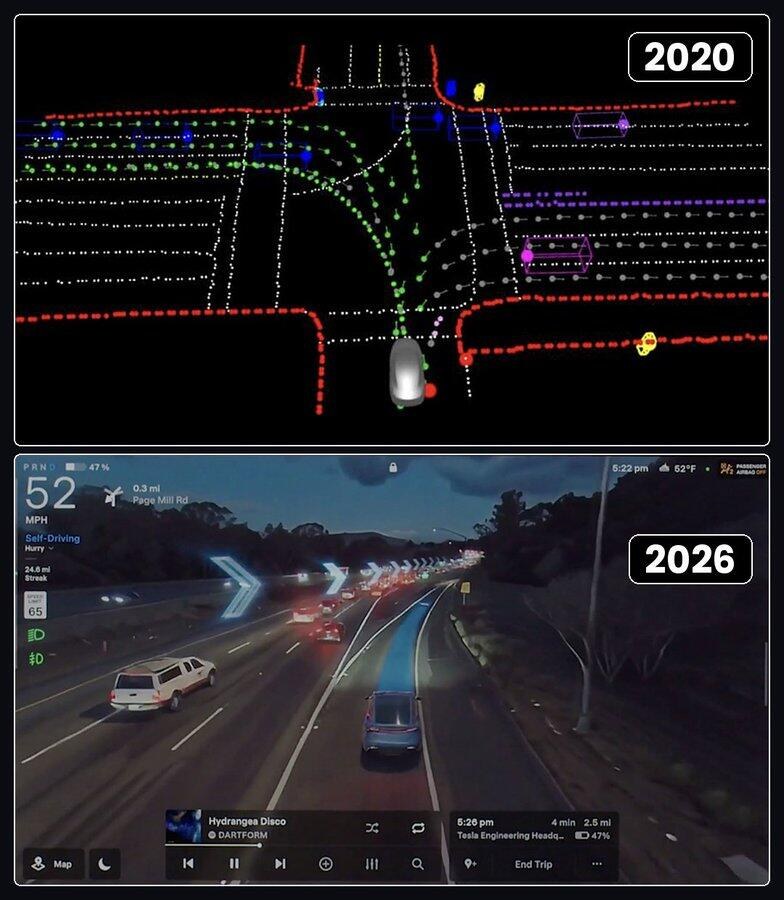
Image: Tesla. The 2020 view draws what the perception stack outputs: lane points, boxes, a path. The 2026 view draws a place.
The 2020 screen is honest in a specific way. Every dot is a number the perception network produced. A lane boundary is a list of points. A car is a box with a class. A separate program then draws those numbers. If the network didn’t output a thing, the thing isn’t on the screen.
The v15 screen has no such list behind it. The release notes describe “a generative visualization” streamed “from an arbitrary virtual camera situated above your vehicle”. Elluswamy’s version is shorter: “Produced end-to-end, pixels-in-pixels-out.” And Musk: “real-time AI video generation (no gaming engine!) using just half of one AI4 TRIP accelerator.”
So the question I started with, “how do they make the 3D elements look so real”, has a strange answer. They don’t make 3D elements. There aren’t any.
图片:Tesla。2020 年的界面画的是感知系统的输出:车道点、方框、一条路径。2026 年的界面画的是一个地方。
2020 年那块屏幕有一种很具体的诚实。每一个点,都是感知网络输出的一个数。车道边界是一串点,车是一个带类别的框。然后另有一个程序把这些数画出来。网络没输出的东西,屏幕上就没有。
v15 的屏幕背后没有这样一张清单。发布说明的描述是”生成式可视化”,”从位于车辆上方的任意虚拟摄像头”串流出来。Elluswamy 的版本更短:”端到端产生,像素进,像素出。”马斯克则说:”实时 AI 视频生成(没有游戏引擎!),只用了一颗 AI4 TRIP 加速器的一半。”
所以我一开始想问的那个问题,”他们是怎么把那些 3D 元素做得这么真的”,答案有点怪:他们没有做 3D 元素。根本就没有 3D 元素。
Taking three frames apart
Before theorising, look. These are three of Tesla’s own frames. I went through them element by element and asked one question of each: who drew this?
把三帧画面拆开
先别急着讲理论,先看。下面是特斯拉自己放出的三帧画面。我一个元素一个元素地过了一遍,对每一个只问一个问题:这是谁画的?
Three things came out of that for me.
The speed, the gear and the media cards are ordinary UI. Sharp text in fixed places, alpha-blended over the video. Nothing new.
The world is generated, and you can catch it. The lit sign in the city frame has the shape of writing and no letters. Distant traffic turns into a smear of red. A renderer working from an object list doesn’t fail like that. A generator does.
The blue things are the interesting part. The ribbon and the chevrons aren’t the world. They’re the car’s plan. They still fade with distance, keep one lane’s width, hang at a steady height, and glow. Whoever draws them knows where the ground is. I’ll come back to these.
这一轮看下来,我得到三点。
车速、挡位、媒体卡片是普通 UI。 位置固定的锐利文字,用 alpha 混合叠在视频上。没有新东西。
世界是生成的,而且你抓得到它。 城区那一帧里亮着的招牌,有字的形状,没有字。远处的车流糊成一片红。拿着物体清单的渲染器不会这样出错,生成器会。
蓝色的那些才是有意思的部分。 光带和箭头不属于世界,它们是车的计划。可它们照样随距离变淡,保持一条车道的宽度,悬在稳定的高度上,还会发光。画它们的那个东西,知道地面在哪。这个我后面再讲。
The render system
Musk explained it himself, in two replies. Here they are in full, because every sentence is doing work:
We’ve had a ~pixel-perfect world model since last year, which is critical for synthetic data generation.
The (much) smaller version of that in the car is a conditional mean-flow model, based on the recent sequence of Tesla Universal Vision Encoder features, which are the same ones that are plugged into the 3B encoder model that produces the driving actions.
We fork off from these UVE features, then run a separate ~1B diffusion model. This takes in the previous reality-view generation with added noise and then denoises it to the current visualization.
It then produces a small video chunk (8 images at 36 fps, at the resolution of the UI screen). This work is done by 1/2 of a TRIP engine every UVE frame at 18 hz and is spread over 4 cycles.
Currently, the latency is a bit high due to compute constraints, but we have ways to interleave newer UVE features along the diffusion transformer layers to cut roughly 35% of the latency.
After we moved our tiny decoder into SRAM, we only have half a TRIP out of three on SoC B, for this reality visualizer, so spent the compute as best we could. TRIP basically only handles 8-bit int and has to run softmax in emulation mode in 28 steps.
AI5 is a gigantic improvement. Roughly 12X more compute.
Now the same thing as a place you can walk through. Follow one frame from the lens to the glass.
渲染系统
马斯克自己解释过,一共两条回复。我全文放在这里,因为每一句都有用(原文为英文,以下是我的翻译):
我们从去年起就有了一个近乎像素级完美的世界模型,这对合成数据生成至关重要。
车里跑的是它的一个(小得多的)版本:一个条件均值流模型,以最近一段特斯拉通用视觉编码器(UVE)特征序列为条件。这些特征,和接进那个产生驾驶动作的 30 亿参数模型的,是同一份。
我们从这些 UVE 特征分叉出去,再跑一个独立的约 10 亿参数的扩散模型。它接收上一次的 reality-view 生成结果,加上噪声,然后去噪成当前的可视化画面。
接着它产出一小段视频(8 张图,36 fps,分辨率就是 UI 屏幕的分辨率)。这份活由半个 TRIP 引擎完成,每个 UVE 帧(18 Hz)都在跑,摊在 4 个周期里。
目前因为算力受限,延迟有点高。不过我们有办法沿着扩散 Transformer 的各层穿插喂入更新的 UVE 特征,砍掉大约 35% 的延迟。
把我们那个很小的解码器挪进 SRAM 之后,SoC B 的三个 TRIP 里,我们只剩半个可以给这个 reality 可视化用,所以只能把这点算力尽量花好。TRIP 基本上只能处理 8 位整数,softmax 还得用模拟模式跑 28 步。
AI5 是巨大的提升,算力大约是 12 倍。
下面是同一件事,做成了一个可以走进去的地方。跟着一帧画面,从镜头走到玻璃。
The design choice I like most is the split. The driving network never sees the picture. The picture never feeds back into the driving. They only share the encoder. That means the visualisation can be late, soft, or wrong, and the car drives exactly the same. It also means the picture isn’t proof of what the driver “sees”. It’s a second reader of the same features, and a much more imaginative one.
Strip the car away and this is a problem with a name: novel view synthesis. You have some views of a scene. You want the view from a camera that wasn’t there. The recent way to do it is the one Tesla took: don’t reconstruct geometry and render it, train a video generator and condition it on the camera pose.
It’s the same path as our ViewNeXt. There, a video diffusion model takes a few posed reference images plus a list of target cameras, and generates the views along that camera path. Reality View is that recipe with the dials turned: the references are eight live cameras (as encoder features, not pixels), the target is one drone pose behind the car, and the whole thing has to run on half an accelerator at 36 frames a second.
The training data follows from that too. No camera has ever filmed the car from above, so real fleet video alone can’t supply the targets. You need a mix: real data so the result looks like the world, and simulated data so you have ground truth for viewpoints nobody recorded. Musk’s first sentence says where the simulated half comes from: a “~pixel-perfect world model” built for “synthetic data generation”. A year ago, in his ICCV write-up, Elluswamy also showed “generative Gaussian splatting” that rebuilds a scene from fleet video in about 220 ms. Rebuild a real drive, render it from the drone pose, draw the plan into it, and you have a training pair. How Tesla actually mixes the two is my inference. That it’s a pose-conditioned video generator is, at this point, pretty much what they’ve told us.
我最喜欢的设计是这个”分叉”。驾驶网络从来看不到这幅画面,画面也不会反馈回驾驶。它们只共用编码器。这意味着可视化可以晚、可以糊、可以错,车照样一模一样地开。这也意味着,画面并不能证明驾驶网络”看到了”什么。它是同一份特征的第二个读者,而且是想象力丰富得多的那个。
把车拿掉,这其实是一个有名字的问题:新视角合成。你有一个场景的几个视角,想要一个当时并不存在的相机看到的画面。近两年的做法,就是特斯拉走的这条:不去重建几何再渲染,而是训练一个视频生成器,用相机位姿作为条件。
这和我们的 ViewNeXt 是同一条路。在那里,一个视频扩散模型拿到几张带位姿的参考图,加上一串目标相机,就生成沿着这条相机轨迹的画面。Reality View 是同一个配方,只是几个旋钮拧到了头:参考是八个实时摄像头(以编码器特征的形式,而不是像素),目标是车后方的一个无人机位姿,而且整件事要在半个加速器上跑到每秒 36 帧。
训练数据也就顺理成章了。从来没有哪台摄像头从上方拍过这辆车,所以光靠真实的车队视频凑不出训练目标。你需要混着来:真实数据让结果看起来像这个世界,仿真数据给那些没人拍过的视角提供真值。仿真那一半从哪来,马斯克第一句就说了:一个”近乎像素级完美的世界模型”,用途是”合成数据生成”。一年前,Elluswamy 在 ICCV 的那篇文章里还展示过”生成式高斯泼溅”,用车队视频在大约 220 毫秒内重建一个场景。把一段真实行驶重建出来,从无人机位姿渲染,把规划画进去,就得到一对训练样本。两种数据具体怎么混,是我的推断。至于它是一个以位姿为条件的视频生成器,到这一步,基本就是他们自己告诉我们的了。
Why it looks whole
Here’s the part that I think people underestimate. A car’s cameras sit about a metre off the ground and look outward. From there you see the near side of everything and the far side of nothing. The screen shows the scene from above, with every car complete.
它为什么看起来是完整的
这是我觉得大家低估了的部分。车上的摄像头离地一米左右,朝外看。从那个位置,你能看到每样东西朝着你的那一面,看不到任何东西的背面。屏幕上却是从上往下看的,每辆车都是完整的。
So the realism comes from two places. The encoder carries the geometry: where things are, how big, how they move. It has to, the car steers from it. The generator carries the appearance: what a car’s roof looks like, what wet asphalt does under a street light, what the far side of an SUV probably is. Put the two together and you get a picture that’s right about positions and plausible about everything else.
“Plausible about everything else” is doing a lot of work in that sentence. One early reviewer called the result “messy” next to the old vector display. I think that’s the same observation from the other side. The old screen showed less and meant all of it.
所以这份真实感有两个来源。编码器带着几何:东西在哪、多大、怎么动。它必须带着,车是靠它打方向的。生成器带着外观:车顶长什么样,路灯下的湿路面是什么效果,一辆 SUV 的另一侧大概是什么。两样合在一起,你得到的画面就是:位置是对的,其他一切是”说得过去的”。
“其他一切说得过去”这半句,分量很重。有一位早期体验者说,和老的矢量显示比,它显得”乱”。我觉得这是同一个观察,从另一面说出来的。老屏幕画得少,但画出来的每一样都是当真的。
Why it’s real-time
A video diffusion model on a car computer sounds absurd. The usual ones need dozens of network passes per output. At 36 frames a second, you don’t have dozens of anything.
“Mean-flow” is the answer. Quick version. A flow model learns a velocity field $v(z_t, t)$ that pushes noise towards data. To generate, you integrate it, which means many small steps, one network call each. A mean-flow model (Geng et al., 2025) learns the average velocity over a whole interval instead:
\[u(z_t, r, t) = \frac{1}{t-r}\int_r^t v(z_\tau, \tau)\,d\tau\]If you know $u$ for the whole trip, you don’t integrate anything. You jump:
\[z_r = z_t - (t - r)\,u(z_t, r, t)\]One call. The cost moves from inference to training, where the network has to satisfy an identity that ties the average velocity to the instantaneous one. Musk doesn’t say how many steps Tesla’s model takes. The name says it’s few.
它为什么能实时
在车载电脑上跑视频扩散模型,听起来很离谱。常见的那些,每出一次结果都要过几十遍网络。一秒 36 帧,你什么东西都没有”几十遍”的预算。
答案是”均值流”。长话短说:流模型学的是一个速度场 $v(z_t, t)$,把噪声推向数据。生成的时候要对它做积分,也就是很多小步,每一步一次网络调用。均值流模型(Geng 等,2025)学的则是一整段区间上的平均速度:
\[u(z_t, r, t) = \frac{1}{t-r}\int_r^t v(z_\tau, \tau)\,d\tau\]如果整段路程的 $u$ 你都知道,那就不用积分了,直接跳:
\[z_r = z_t - (t - r)\,u(z_t, r, t)\]一次调用。代价从推理挪到了训练:网络在训练时必须满足一个把平均速度和瞬时速度绑在一起的恒等式。特斯拉的模型具体走几步,马斯克没说。但这个名字说明,步数很少。
The second trick is in that demo too. Each new chunk starts from “the previous reality-view generation with added noise”, not from pure noise. Two wins. The trip is short, so a small model can do it. And the scene carries over, so the street doesn’t get repainted from scratch five times a second.
第二招也在这个演示里。每一段新画面不是从纯噪声开始,而是从”上一次的 reality-view 生成结果加上噪声”开始。两个好处:路程短了,小模型也走得完;场景延续下来了,街道不会每秒被从头重画五遍。
A fifth of a second
Nothing’s free. The generator works in chunks of 8 frames. At 36 fps that’s 0.22 seconds, which is exactly the four 18 Hz encoder cycles Musk says the work is spread over. So what you’re looking at is always a bit old.
The reason is the hardware. The painter gets half of one TRIP engine, out of three on that chip. TRIP only does 8-bit integer math, and a transformer’s softmax has to be emulated in 28 steps. A billion-parameter diffusion transformer on that budget is a stunt. AI5 is supposed to bring about 12 times the compute.
五分之一秒
天下没有白吃的午餐。生成器是 8 帧一段地干活的。36 fps 下就是 0.22 秒,正好是马斯克说的、这份活所摊开的那 4 个 18 Hz 编码器周期。所以你看到的画面,永远是有点旧的。
原因在硬件。画师只分到那颗芯片上三个 TRIP 引擎里的半个。TRIP 只会做 8 位整数运算,Transformer 里的 softmax 得用 28 步去模拟。在这点预算上跑一个十亿参数的扩散 Transformer,本身就是一场杂技。AI5 据说会带来大约 12 倍的算力。
At highway speed that’s more than a car length. For a display, that’s fine. It isn’t the control loop. But it matters the moment you start touching the screen, because you’re pointing at where things were.
在高速上,这就是一个多车身的距离。作为显示,没问题,它不在控制回路里。可一旦你开始用手去点屏幕,它就要紧了,因为你指着的,是东西刚才所在的位置。
The blue light
Now the part everyone screenshots. Why does the blue path look like it’s in the scene and not stuck on top of it?
I rebuilt the look to find out. It comes down to five small things.
那道蓝光
现在说所有人都在截图的那部分。那条蓝色路径,为什么看起来是在场景里,而不是贴在上面的?
为了弄明白,我照着样子重做了一遍。归根到底是五件小事。
There are two ways to get those five things, and I can’t tell from stills which one Tesla uses.
Composited. The planner hands over a path in 3D. Since the virtual camera’s pose is known, you project the path to the screen, test it against a depth map, add it with a bloom pass. That’s a game-engine overlay, and it’d be pixel-stable and exact.
Generated. The plan goes into the generator as conditioning, and the generator paints the ribbon the same way it paints tail lights. It learned to, because the training videos had the ribbon in them. Then the fade, the glow and the spill come for free, and so do the failure modes: a ribbon that wobbles, or bends around something that isn’t there.
Elluswamy’s “pixels in, pixels out” points to the second. If you have a car with v15, here’s what I’d check: pause on a frame where the ribbon passes close to another car. If the car’s paint picks up blue, that’s a generator, or a very careful compositor. If the ribbon’s edge is razor sharp while the road under it shimmers, that’s an overlay.
要拿到这五样,有两条路,而单看截图,我分不出特斯拉走的是哪条。
合成。 规划器给出一条三维路径。虚拟相机的位姿是已知的,于是把路径投影到屏幕上,和一张深度图做遮挡测试,再过一遍泛光加上去。这就是游戏引擎式的叠加,它会是像素级稳定、精确的。
生成。 规划结果作为条件送进生成器,生成器像画尾灯一样把光带画出来。它学会了这么画,因为训练视频里本来就有光带。于是变淡、发光、溢光都是白送的,连带着失败的方式也白送:光带会抖,或者绕着一个并不存在的东西拐弯。
Elluswamy 那句”像素进,像素出”指向第二种。如果你手上有一辆装了 v15 的车,我会这样验证:在光带贴近另一辆车的那一帧暂停。如果那辆车的车漆染上了蓝色,那要么是生成器,要么是一个非常讲究的合成器。如果光带的边缘锋利如刀,而它底下的路面在微微闪动,那就是叠加层。
Making it interactive
Musk’s pitch is that you can touch a spot and the car goes there. That sounds like it needs the screen to “understand” the scene. It doesn’t. It needs one fact: where the virtual camera is.
让它能交互
马斯克的说法是:你点一个位置,车就开过去。听起来好像屏幕得”理解”场景才行。其实不用。它只需要一个事实:虚拟相机在哪。
The camera is fake, but its pose is a number the system picked. Pixel plus pose gives a ray. Ray plus ground gives a point in the car’s own coordinates. From there it’s an ordinary goal for the planner.
That’s also why I’m not surprised early testers found it flaky. One reported that tapping didn’t change the chosen bay at all. The geometry takes an afternoon. The product needs the generated ground and the planner’s ground to agree to within a parking bay while the picture runs a fifth of a second late, and then it needs the car to show you it understood before it moves.
相机是假的,但它的位姿是系统自己选的一组数。像素加位姿,得到一条射线。射线加地面,得到车自身坐标系里的一个点。从这往后,就是规划器的一个普通目标。
这也是为什么早期测试者说它不稳,我一点都不意外。有人反馈,怎么点都换不了选中的车位。几何一个下午就能写完。产品要的是:在画面晚了五分之一秒的情况下,生成出来的地面和规划器的地面要对齐到一个车位以内;然后,车还得在动之前,先让你看到它听懂了。
What I’d do next
If this were my system, in rough order:
-
Show what’s invented. Right now a car the cameras see clearly and a car the model is guessing at look the same. That’s a trust problem. The model already knows which regions have camera support. Dim the rest, or draw it as outline. The old screen’s honesty, with the new screen’s looks.
-
Paint the present, not the past. The system has the plan. It knows roughly where the car will be in 0.2 seconds. Condition the generator on that, and render the frame for when it’ll be shown. The planned fix cuts the lag by a third. Prediction could hide most of the rest.
-
Let me move the camera. The pose is already an input. Give me a drag to orbit, a pinch to pull up to a map-like top view, and the map itself becomes one end of a single continuous camera move.
-
Use it as a probe. A second network reading the driver’s features is an interpretability tool, with one big caveat: the painter can add things the features don’t contain. So test it. Take cases where the driving network demonstrably didn’t react to something, and check whether the painter drew it anyway. If it did, the picture is lying about what the driver knows.
-
Close the loop on the tap. Tap, and the ribbon redraws to the new goal before the car moves. Now the screen is a conversation: I point, it shows me its plan, I confirm by doing nothing.
-
Do it for robots that aren’t cars. This is the one I care about. Every robot I’ve worked with has the same problem: the person next to it can’t tell what it’s about to do. A third-person view, generated from the robot’s own features, with its intent painted into the scene, is a general answer. The encoder here is reportedly shared with Optimus already.
接下来我会做什么
如果这是我的系统,大致按这个顺序:
-
把编出来的部分标出来。 现在,一辆摄像头看得清清楚楚的车,和一辆模型在猜的车,长得一模一样。这是个信任问题。模型本来就知道哪些区域有摄像头的证据。把其余的调暗,或者只画轮廓。老屏幕的诚实,加上新屏幕的颜值。
-
画现在,别画过去。 系统手里有规划结果,它大致知道 0.2 秒后车会在哪。把这个作为条件喂给生成器,让它渲染”这一帧被显示出来的那一刻”。计划中的修复能把延迟砍掉三分之一,预测可以把剩下的大部分藏起来。
-
让我动相机。 位姿本来就是输入。给我一个拖动来环绕,一个双指捏合拉到接近地图的俯视,这样地图本身就成了同一段连续运镜的一端。
-
拿它当探针。 第二个网络去读驾驶网络的特征,这就是一个可解释性工具,但有一个大前提:画师会添上特征里没有的东西。所以要去测。找那些驾驶网络明显没有对某个东西做出反应的案例,看画师是不是照样把它画出来了。如果是,那这幅画面在”驾驶网络知道什么”这件事上就是在撒谎。
-
把点击这条回路闭上。 点一下,光带先重画到新目标,车再动。这样屏幕就成了一场对话:我指,它给我看它的计划,我什么都不做就算确认。
-
给不是车的机器人也做一个。 这是我最在意的一条。我做过的每一台机器人都有同一个问题:站在它旁边的人,看不出它下一步要干什么。一个第三人称视角,由机器人自己的特征生成,把它的意图画进场景里,这是一个通用的答案。据称这里的编码器已经和 Optimus 共用了。
Where this leaves me
I came in asking how they render 3D so well. I’m leaving with a different picture. The 3D lives in the features. The realism lives in a generator. The camera is a number. The blue light is the car telling you what it wants. None of it is a model in a scene graph.
That’s a strange object to have on a dashboard. It’s the best-looking thing Tesla has put on that screen, and it’s also the first one where you can’t point at a pixel and say which sensor it came from. I think both of those are going to matter.
我的结论
我进来的时候想问的是,他们是怎么把 3D 渲染得这么好的。走的时候,脑子里是另一幅图。3D 住在特征里。真实感住在生成器里。相机是一组数。那道蓝光,是车在告诉你它想干什么。没有一样是场景图里的模型。
把这样一个东西放在中控屏上,是件挺奇怪的事。它是特斯拉往那块屏幕上放过的最好看的东西,也是第一个让你没法指着某个像素、说出它来自哪个传感器的东西。我觉得这两点,往后都会很要紧。
Sources
All frames are Tesla’s, from the FSD v15 launch material. The technical figures come from Elon Musk’s two replies on X, quoted in full above.
来源
所有画面均来自 Tesla 的 FSD v15 发布素材。技术数字来自马斯克在 X 上的两条回复,上文已全文引用。
- Tesla, FSD (Supervised) v15.0.1 release notes, build 2026.38.6.11, as published by Tesla North and Drive Tesla Canada.
- Ashok Elluswamy, “Produced end-to-end, pixels-in-pixels-out” (X, Nov 2026), and Tesla’s approach to Autonomy (X, Oct 2025) for generative Gaussian splatting and the neural world simulator.
- Elon Musk, two replies on X explaining Reality View (Nov 2026), quoted in full above; also covered by Tesla Newswire and Unite.AI. The “no gaming engine” line via Crypto Briefing.
- Zhang, J., Liu, B., Chen, N., Wang, H., Bei, S., Gong, X., Wetzstein, G., Wang, Y., Fan, Z. (2026). ViewNeXt: Diffusion-Based View Synthesis Revisited.
- Hands-on reports: Teslarati, kingy.ai.
- Frames: paultan.org, ZeroHedge.
- Geng, Z., Deng, M., Bai, X., Kolter, J. Z., He, K. (2025). Mean Flows for One-step Generative Modeling. arXiv.